Embracing GenAI: A new era for industrial efficiency
Posted: August 19, 2024
A few weeks ago, I attended an external conference about data and AI. The event was so informative and insightful that I felt compelled to write about it on the plane ride home. I couldn’t wait, fearing I might lose the inspiration. Like many others there, I was eager to grasp tangible ideas about how AI would impact my work and industrial organizations in the future. Whether we like it or not, AI is rapidly advancing. It seems like just yesterday that ChatGPT took the news by storm and left us all astonished.
Since then, new use cases for generative AI (GenAI) have emerged. During one of the conference keynotes, the presenter demonstrated live (bravo!) how they could cross-reference all cookie sales data from a specific franchise location with social media reviews. They then asked an AI tool to generate an Instagram ad for the cookie franchise, complete with design and copy and send it to their marketing team via Slack for review. The outcome was amazing! Beyond scaring lots of social media managers in the audience, the demo was an eye opener of possibilities. Here’s the screenshot of the Slack message:

Impact on the industrial sector
But what does this have to do with the industrial sector? In our field, we are always striving to improve by increasing production, reducing waste, operating more sustainably, minimizing equipment downtime, and more. To solve bigger problems, data alone is not enough; you need data plus AI-based analytics.
“Digitalization and AI offer powerful capabilities to transition industries away from resource-intensive, low-tech systems to high-tech, and high-value ones. We are seeing smart city infrastructure to the chemical inustry increase focus on circularity and sustainability, through to the power industry pushing further towards green frontier technology. Manufacturing is also shifting towards on-demand goods production and other industrial sectors are embracing data-centric industrial intelligence.”
Caspar Herzberg, Chief Executive Officer, AVEVA
Imagine being able to analyze, cross-reference, and get answers to all your questions without relying on large spreadsheets, complex database queries, numerous IT requests, and weeks of work. That’s where GenAI comes in, providing a streamlined interface where you can pose questions in natural language, such as:
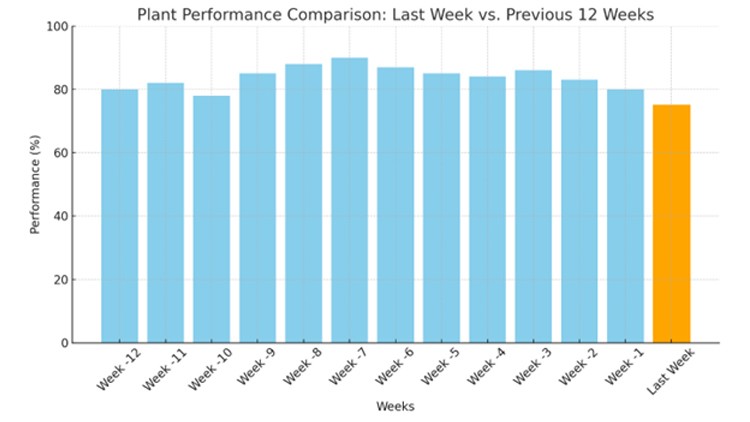
User: How was the plant performance last week compared to the past 12 weeks?
Gen AI Tool: There was a decline in production. Here’s a bar chart to compare the plant performance of last week with the performance over the past 12 weeks.
But it doesn’t stop there—you can dive deeper:
User: What caused the decline in production?
Gen AI Tool: The decline in production last week was primarily due to unexpected maintenance on the dough mixing machines and a shortage of raw materials.
User: Create an alert that is sent to the operations group next time the total elapsed runtime for mixing machines falls below our standard level.
GenAI Tool: I will set up an alert to notify the operations group if a similar decline in equipment runtime occurs in the future.
User: Also, create a model to notify suppliers when an upcoming shortage of raw materials is predicted.
GenAI Tool: I will create a predictive model to notify suppliers when an upcoming shortage of raw materials is anticipated. The model will analyze historical data, current inventory levels, and production schedules. Would you like to set any specific parameters for the notifications?
User: Yes, set the threshold to notify suppliers when the raw material levels drop below a two-week supply based on current production rates.
GenAI Tool: Understood. Should these notifications include a recommended order quantity?
User: Yes, include a recommended order quantity based on average consumption rates over the past three months.
GenAI Tool: I will do that. The notifications will now be sent to suppliers accordingly.
Is this fictional? Yes. Surreal? Not at all! The demonstrations I saw during the conference prove we’re closer to this reality than we think. This revolution is here and will affect all of us, so let’s be ready to embrace it.
GenAI is only as good as the data it’s trained on
A key message reiterated at the conference was that AI relies on high-quality, accurate data. Therefore, industrial organizations must evolve their data management methods. The proven method with on-premises historians is still highly valuable and necessary, but it might be time to add a new element: the cloud.
This hybrid approach combines all relevant industrial data from on-premises sites, remote and mobile assets, IoT sensors, and from the cloud. An expanded infrastructure opens up many new opportunities for using industrial data. Business partners, when authorized, can easily access data to help them monitor equipment critical assets in your operations or restock raw materials. All data can be integrated into a central repository, allowing remote workers to see everything they need, no matter where they’re physically located. You can combine rich historical and near-real-time data to be GenAI-ready.
But here’s the catch: time-series, event or engineering data is not that easy to manage. There are few solutions in the market equipped to deal with the volume, the granularity and the speed at which industrial data is generated, not to mention attaching the context that helps users understand it. If you’ve ever tried to extract time-series data from a historian, you’ll know what I mean. We came across several cases of customers who tried to build a self-service, edge-to-plant-to-cloud data solution by themselves and the pattern is almost always the same: a discontinued project because of extensive timeline and high costs.
So what do I do? How should I start?
Simply dumping all your data into a data lake won’t solve the problem. You need context, security, and cleansed data ready for consumption. Otherwise, you’ll generate additional costs and distractions. As some AI speakers have said, “garbage in, garbage out.”
For over 50 years, AVEVA has provided industrial organizations with cutting-edge software solutions. With the addition of CONNECT, industrial organizations can have their data in the cloud in a few minutes—either real-time or 100 years’ worth of historical data. CONNECT is ready for the task. With native data connectors, contextualization, and data shaping, your data is immediately ready for consumption by humans or machines. The result: a high-performing, future-ready hybrid structure!
Last year at AVEVA World, our Chief Product Officer, Rob McGreevy, gave an incredible presentation showcasing GenAI in the industrial world. If you haven’t seen it, I highly recommend checking it out.
As the captain announces our descent and the flight attendant politely asks me to put my laptop away, I conclude with a reflection: Are you set to make your organization future-proof through AI? Book a call with one of our CONNECT experts and let us help you get there.
Related blog posts
Stay in the know: Keep up to date on the latest happenings around the industry.


